Baggy Dreams on State Street: A 1990s Chicago Style Scrapbook
Some people remember the 1990s in mixtapes or TV reruns. I remember it in escalators and hemlines, in the whoosh of Marshall Field’s revolving doors on State Street and the way my reflection changed in every polished glass display. My style story is basically one long Field’s field trip, a rotation of denim, flannel, and teenage bravado played out under fluorescent lights and marble columns.
Baggy Denim, Big Feelings
The early ’90s version of me arrived at Marshall Field’s swaddled in denim so oversized it practically echoed. My jeans sat low on my hips, all puddled hems and frayed edges, paired with flannel shirts at least two sizes too big. I’d stomp off the Red Line, the wind off the lake slicing straight through the canyon of State Street, and suddenly there it was: the green clocks, the brass doors, and the faint swirl of perfume.
On Saturdays, my friends and I would ride the wooden escalators like they were escalators to adulthood. We’d pretend we were just “passing through,” but really we were on a pilgrimage to the juniors’ floor. There, under the buzzing lights and racks crammed with acid wash, I fingered the seams of the baggiest jeans I could find, hunting for the sweet spot between “can barely walk” and “can hide my entire adolescent awkwardness inside these pant legs.”
Back then, style was armor. The bigger the denim, the smaller I hoped my insecurities would feel. Still, even under all that fabric, the constant was my love of detail: the right wash, the perfect scrunched cuff over Reebok Classics so white they practically glowed against the dingy train platforms.
Grunge, But Make It Department Store
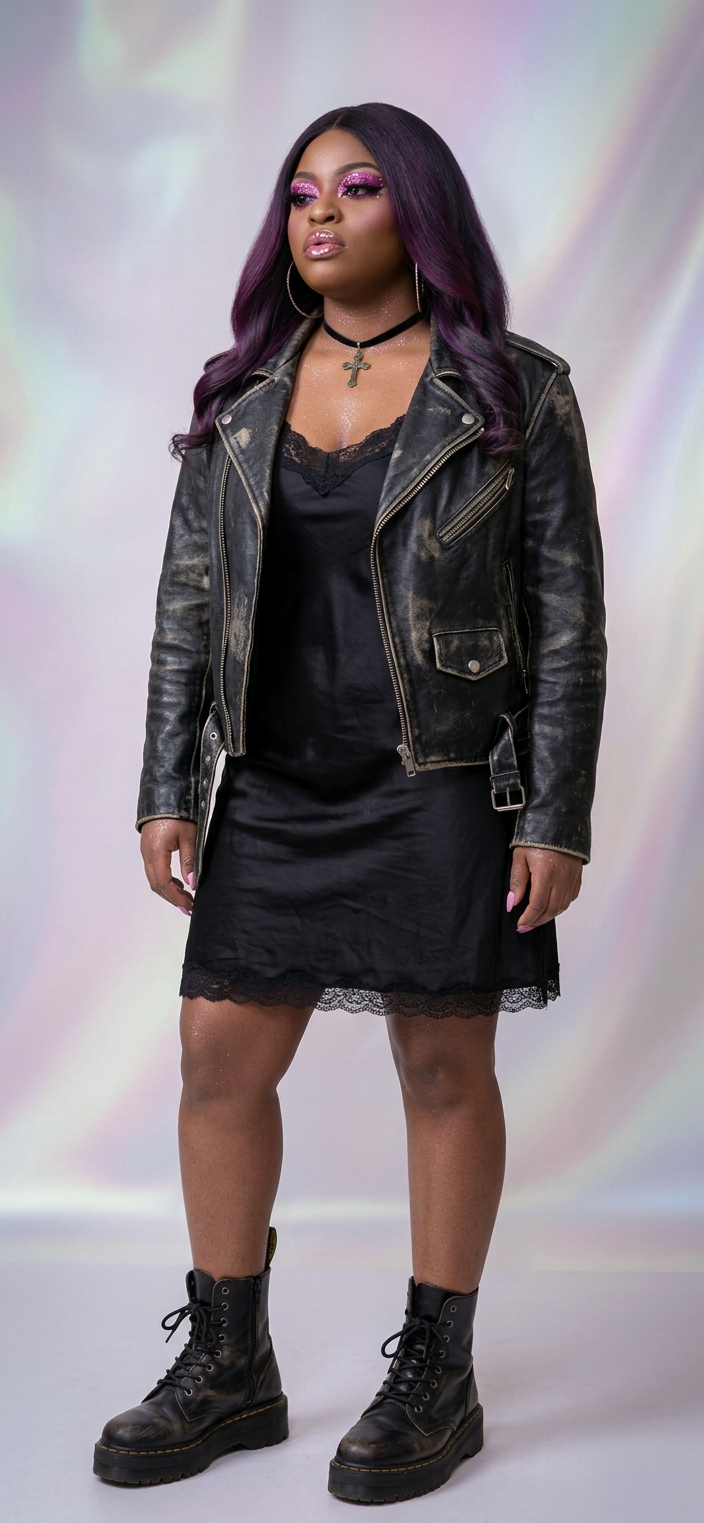
When grunge floated in from Seattle like lake-effect clouds, Marshall Field’s translated it into something faintly respectable. On one of those gray Saturdays when the sky matched the Chicago River, I stepped through the revolving doors and the mannequins had changed: out went the hyper-baggy jeans, in came bias-cut slip dresses layered over white tees.
I tried on a black satin slip in a dressing room that smelled like hairspray and new carpeting. The lining swished against my knees as I shifted under the too-bright bulbs. Over it, I threw my old oversized flannel, still scented with cheap body spray and last night’s fries. It shouldn’t have worked, but it did somehow—the softness of the dress, the roughness of the plaid, my Reebok Classics stubbornly peeking out underneath like a reminder that I was still me.
That day I realized something: my style wasn’t about starting over every season. It was about layering the new over the old, literally and figuratively. The flannel stayed. The sneakers stayed. The attitude softened, just a little. I started to wonder what it might feel like to be seen, not just shielded by fabric.
Overalls, Crop Tops & Summer on State
By the time summers started to blur together in a haze of bus passes and iced coffees, I had migrated to denim overalls and tiny crop tops. Field’s was my air-conditioned oasis, a place to linger when the sidewalks shimmered and the Orange Line platforms felt like griddles.
I remember one afternoon when the revolving doors exhaled a wave of cool air and perfume so strong it almost tasted like powdered sugar. I beelined to the junior denim section, my overalls unhooked on one side in that very specific “I saw this in a music video” way. Hanging there were overalls that were slightly slimmer, slightly more grown-up, still practical but with slimmer straps, darker washes, brass buttons that caught the light.
I slipped into a pair in the fitting room and stared at myself. The crop top I’d worn on the train—a ribbed baby tee in pale pink—peeked out from underneath the bib. My stomach, for once, didn’t feel like something to hide. The denim hugged rather than swallowed me. My Reebok Classics, a little dingier now, grounded the whole look. The constant: I still needed shoes that could handle running for the bus and dashing across intersections under blinking red hands.
Outside, State Street roared with buses and cabs, but inside Marshall Field’s everything felt suspended—just me, my reflection, and the possibility that I could dress for the life I wanted instead of just the life I had.
Plaids, Baby Tees & Hallway Runways
The next chapter of my style scrapbook is written in plaid. Blame it on teen movies or private-school fantasies, but suddenly I wanted pleated skirts that actually swung when I walked. Marshall Field’s delivered: racks of tartan minis in cherry red, hunter green, and a surprisingly chic black-and-white check.
I paired them with baby tees so fitted they felt like second skin, the cotton soft from a hundred washes. I remember brushing my fingers along the pleats, listening to the distant murmur of announcements over the store’s PA system and the soft thud of heels on carpet behind me. I’d slip on a cardigan—sometimes slouchy, sometimes snug—and suddenly I was a slightly more polished version of my grunge self. Less “borrowed from my older cousin,” more “I chose this on purpose.”
After school, my friends and I turned the tiled hallways of State Street’s subway stations into our own runways, pleats swishing, cardigans tied around our shoulders when we got too warm. My Reeboks, now scuffed and creased, were still the through line — proof that even as my hems climbed higher, my feet remained planted firmly in the city’s grit.
Blazers, Briefcases & Grown-Up Floors
Somewhere between late high school and early “real world,” everything shifted. I still rode downtown on the same trains, still cut across State Street with headphones on, but now I rode the escalators to different floors at Marshall Field’s. Out of juniors, up into the grown-up worlds of wool and worsted, of “career wear” instead of “weekend.”
The first time I tried on a tailored blazer there, I half expected security to tap me on the shoulder and ask me to return to my regularly scheduled adolescence. The fabric had structure, like it knew who it was. Standing in front of those three-way mirrors, I smoothed the lapels and recognized, with a jolt, that some part of me had been aiming for this all along.
Under the blazer, I wore a simple knit top—a grown-up cousin of the baby tees I’d loved—tucked into trousers that actually hit my ankle instead of swallowing my shoes. I swapped my oversized flannels for cardigans with clean lines, my pleated minis for pencil skirts that whispered when I walked. Still, I wasn’t ready to let go of my roots, literally or figuratively. On shopping days, I’d wear my Reebok Classics with my new workwear, just to test the boundaries. The sales associate looked me up and down, then nodded: “You’ve got your own thing going.”
That was the constant again: my refusal to abandon comfort completely, even as I chased polish. I wanted clothes that could take me from the cubicle to the corner coffee shop, that could weather surprise downpours off the lake and last-minute happy hours on Wabash.
What Stayed, What Changed
Looking back now, my ’90s Chicago style reads like a flipbook you’d find tucked in the back of an old scrapbook: oversized denim snapping into slip dresses, overalls folding into pleated skirts, cardigans straightening into blazers and polished workwear. Each look is anchored to a memory of Marshall Field’s and State Street—the clang of the El overhead, the hum of escalators, the hush of carpeted fitting rooms where I tried on new versions of myself under too-bright lights.
What changed was the silhouette: from baggy to fitted, from hiding to highlighting. What changed was the intention: from copying what I saw in music videos to curating what actually felt like me. My colors softened, then sharpened. My hemlines went up, then down. I traded backpacks for briefcases, lip gloss for lipstick.
What stayed constant was the city under my feet, and the shoes on them. The Reebok Classics might have been replaced eventually, but their spirit lives on in every pair of sneakers I lace up under a blazer today. Comfort, movement, practicality—they were always nonnegotiable. Also constant: my obsession with details. The right cuff. The way a cardigan drapes. The thickness of a blazer’s shoulder padding. Every era was just another draft in the same story.
When I pass the old Marshall Field’s building now, I see all my past selves layered in the glass: the girl drowning in denim, the teen in a grunge slip and flannel, the college kid in overalls and crop tops, the almost-adult in her first real blazer. I carry them all with me, stitched into every outfit I pull on before stepping out into the Chicago wind. The doors may not revolve for me like they used to, but the ritual remains: take a breath, check the reflection, walk forward into whatever comes next, laces tied, head high.