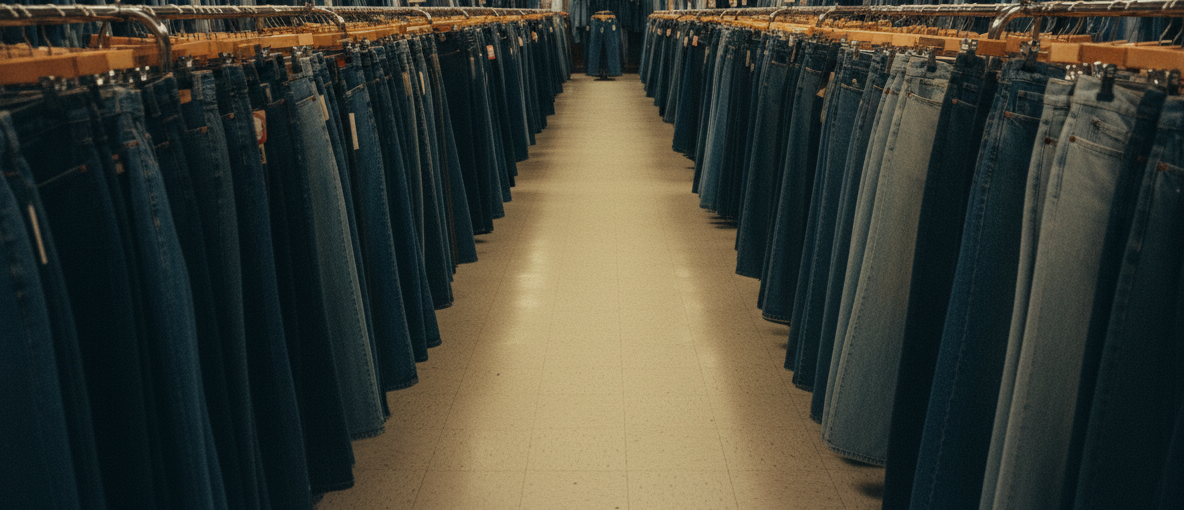

The third floor always felt cooler than the rest of Marshall Field’s, like the air up there had been filtered through indigo. The escalator would sigh me upward from the perfume counters and handbag displays, and as soon as I stepped off, the smell shifted—less floral, more starch and dye, metal hangers sliding on chrome racks, the faint heat of dressing room lights leaking out from behind heavy curtains.
That was my cathedral. Not the Tiffany dome, not the Walnut Room. The denim department, third floor. A forest of jeans as far as I could see, every shade of blue worth believing in.
Saturdays in Blue
Saturdays started on the Red Line, my knees pressed against a shopping bag from last week, headphones fighting the rattle of the train. I would rehearse the brands in my head like a prayer: Levi’s, GUESS, Calvin Klein, DKNY. Four names, four possible lives. By the time I emerged onto State Street, the wind would slap my face awake, the Marshall Field’s clock blinking down at me like it had been waiting.
Inside, the first floor was all polished marble and perfume that hit the back of my throat. But I wasn’t there for gleaming glass cases or cashmere folded like pastries. I was there for the slow ride up through the middle of it all, hand grazing the escalator rail, heart rate picking up with every floor I passed. Second. Third. Denim.
The lighting was different up there—flatter, more practical, humming a little. Fluorescents bounced off metal shelves and mirrored columns. There was a low soundtrack of pop hits, hangers knocking together, register drawers opening and closing like punctuation. Underneath it all, the soft rustle of denim being flipped through, checked, refolded. It was a language of its own.
Levi’s: Learning the Basics
Levi’s was the first stop, always. It felt like the 101 course in who I might be. Stacks of 501s and 505s, folded with military precision, little red tabs peeking out like secret winks. The denim was thick, almost stubborn. When I ran my fingers along the seams, it scratched my skin in that way that promised it would soften with time, mold itself to the exact shape of my days.
The Levi’s section smelled like cotton and cardboard and a little bit like my father’s weekend uniform. Legacy, but with a dressing room. I would grab three sizes of the same wash because I didn’t yet know which version of my body was real: the one in my head, the one in the mirror at home, or the one under Marshall Field’s unforgiving fluorescent lights.
In those fitting rooms—the doors heavy, the hooks always slightly too high—I learned the quiet math of rise and inseam, how a button-fly felt different than a zipper in the most private, literal way. How a barely-there gap at the back of the waistband could make me want to cry, like the jeans were almost ready to believe in me but not quite.
Levi’s taught me patience. How to sit down in front of a mirror and really look, how to admit that the jeans that technically fit didn’t feel like me, and that this was enough to put them back on the hanger and keep searching.
GUESS: The Drama Elective
GUESS was down the aisle, louder somehow, even without saying a word. The jeans were tighter, shinier, stitched with contrast thread that drew deliberate attention to every curve and angle. Back pockets were V-shaped, a little flirty, sometimes with that tiny triangle logo that made my pulse jump.
If Levi’s was English class, GUESS was drama club. The lights seemed warmer in that section, or maybe it was just the way the sales associates moved—hair curled, lip gloss shining, a subtle clack of heels on linoleum. They wore the jeans with an ease I tried to borrow, hips swinging, tags hidden. I watched them when they weren’t looking, studying their walk like it was part of the dress code.
I remember one pair like a scene I never quite got cast in: dark rinse, high waist, zipper at the ankle, the kind of jeans that narrowed your whole life into a sharper line. In the dressing room, the fabric hugged me with almost too much enthusiasm. I could hear the muffled thump of the store’s soundtrack bleeding through the walls, the soft hiss of the air vents, my own breathing getting shallow as I turned side to side, trying on a new level of boldness.
They made me feel like I needed somewhere dramatic to be—an afterparty, a rooftop, at least a crowded hallway where someone would actually notice the back pockets. Standing there under buzzing lights, toes pressing into the thin carpet, I understood that GUESS wasn’t just denim. It was a dare. Wear this and see what happens.
Calvin Klein: Quiet Confidence
The Calvin Klein area was cooler in temperature, or maybe it was just the illusion of it. Lots of white fixtures, clean lines, jeans folded in neat, minimalist stacks. It smelled faintly of the cologne from downstairs, as if the scent had floated up and decided to live there permanently.
Calvin didn’t shout. No loud stitching, no wild embellishments—just smooth denim, subtle fades, that slim little leather patch at the waistband. Slipping into a pair felt like lowering my voice and still somehow being heard. The fabric skimmed rather than clung, and the mirrors in that part of the floor felt kinder, like they were calibrated for nuance instead of spectacle.
In Calvin Klein jeans, I saw a version of myself who ordered espresso without stumbling over the word, who knew the difference between “slim” and “skinny” without looking at the tag, who had somewhere to be that wasn’t just algebra on Monday. They were the jeans I imagined wearing years ahead of my real life, to jobs and dinners and apartments that existed only in the distance between the racks.
Calvin taught me that sometimes the loudest thing you can wear is something quiet that actually fits. The kind of fit where you stop pulling your shirt down self-consciously, where you forget about your jeans altogether until someone says, “Those look really good on you,” and you realize you’ve been breathing normally this whole time.
DKNY: City Girl Training Wheels
DKNY lived closer to the windows, where the light from State Street sneaked in between displays and fell in rectangular patches across the floor. Those jeans always looked like they were on their way outside, mid-stride, headed somewhere urgent and glamorous.
The denim there was a little softer, more broken-in, like it had already lived a life in the city and was inviting me to catch up. There were cargo pockets and zippers and tiny branded tabs, little signals that said, I know where the good coffee is, I can hail a cab in the rain, I don’t get lost on side streets.
I would stand at the window for a minute, pretending to inspect a pair while watching buses exhale at the curb, people rushing past with scarves flying. Inside, the air was climate-controlled and smelled faintly of new fabric and department-store air conditioning. Outside, I imagined it smelled like possibility, like metallic winter wind and street food. DKNY felt like my bridge between those two worlds—training wheels for the city girl I wanted to be.
In the fitting room, those jeans made me walk differently, even in the cramped little space. Heel, toe, turn. The thin mirror wobbled slightly as I shifted my weight, my reflection rippling for a second before settling into someone I didn’t recognize but desperately wanted to.
The Ritual of the Racks
Every visit to the third floor followed the same quiet ritual. First, a slow lap around the perimeter, pretending to browse everything while really just recalibrating myself to the space. The overhead speakers played whatever was on the radio that month, but the real soundtrack was the chorus of hangers sliding along rails, tags flicking against one another, the occasional zip of a dressing room curtain opening just a little too fast.
The racks had weight to them, an almost gravitational pull. When I pushed a row of jeans aside to get to the size I needed, the metal bar would groan softly under the shift. Denim brushed against my knuckles, cool and smooth or rough and rigid, depending on the wash. Dark rinses felt almost silky, while the light stonewashes scratched like they’d been through something.
I learned to read labels like a second language. 26, 28, 30. Regular, short, long. Bootcut, straight, tapered. Each combination suggested a slightly different silhouette, a slightly different way of moving through the world. I would stack two or three pairs over my arm and feel the weight of them—literal, physical proof that I was allowed to experiment with who I was becoming.
Sometimes I brought a friend. We’d trade jeans over the tops of dressing room doors, laughing when something didn’t even make it past a knee, falling into stunned silence when a pair actually worked. That silence was sacred: the moment when your reflection startled you in the best way, when you saw not the body you were trying to hide but the person you were trying to meet.
Denim as a First Language
Denim was the first language I ever used to tell the world who I was. Before I knew how to articulate my taste in art or music or politics, I knew how I wanted my jeans to fit. High enough to make me feel held, long enough to skim over my sneakers just right, dark enough to feel serious or faded enough to say I wasn’t trying too hard.
Every brand on that floor offered a different dialect. Levi’s spoke in tradition and structure. GUESS flirted and declared. Calvin Klein murmured something sleek and grown. DKNY tossed in a city slang I wanted to be fluent in. I tried them all on, collecting phrases of selfhood until they started to sound like my own voice.
In those mirrors, under those lights, I negotiated with myself. Who am I allowed to be? How much space can I take up? What if I choose the bolder cut, the tighter fit, the darker wash—will they still recognize me at home, at school, on the train? Will I still recognize myself?
The third floor gave me the room to ask those questions without ever saying a word. No one rushed me. I could spend an hour and leave with nothing but red marks on my hips and a growing sense of what no longer felt right. That, too, was an education: the courage to walk away from almost-right.
What We Lost When the Escalator Stopped
When Marshall Field’s closed, people talked about the big things first—the name on the bags, the Walnut Room at Christmas, the clock. I thought about the third-floor denim racks. I thought about all that blue fabric, all those mirrors, all the quiet little transformations that had taken place under fluorescent light while the rest of the city kept moving outside.
Now, when I walk into certain department stores, the denim sections feel like watered-down versions of that era: brighter graphics, louder displays, more chaos, less ceremony. The jeans are still there, of course, in their endless sizes and cuts. But the air doesn’t hum in quite the same way. The escalators lift you, but they don’t deliver you into a sanctuary.
We lost a place where trying on clothes felt like trying on futures with just enough privacy to be honest about what fit and what didn’t. We lost the particular kindness of sales associates who remembered your size, who would slide a new pair under the dressing room door without making a production of it. We lost the familiar soundtrack of hangers and pop songs and muffled conversation echoing down long aisles of possibility.
I still have a pair of Levi’s from those days, softened now to the color of morning light. The patch at the back is cracked, the hems a little frayed, but when I pull them on, I can feel the ghost of that third floor—the chill of the air conditioning on my arms, the scratch of tags at my waist, the metallic whisper of the escalator that carried me there over and over again.
Marshall Field’s is gone, but the denim department, third floor, lives on in the way I still treat jeans shopping like a ritual instead of a chore. In the way I still chase that feeling of stepping out of a dressing room, heart pounding, into a wider world where the right pair of jeans could make me braver. We lost the building. I kept the language.