
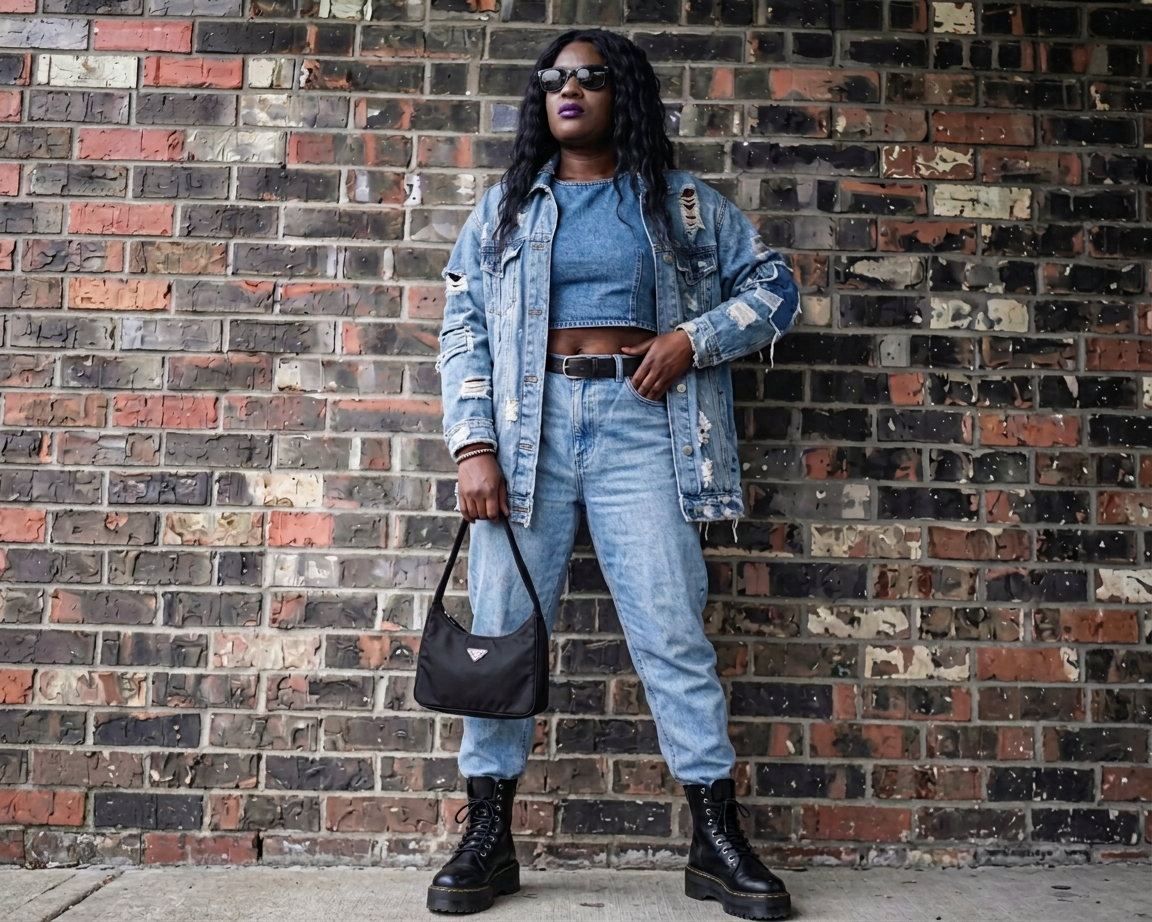
Picture this: it’s 1992. You’re at the mall, Walkman clipped to your belt loop, scrunchie on your wrist, and you spot her — head to toe in denim. Jacket. Jeans. Sunglasses. Boots. She looks like she could front a band, star in a music video, or simply walk down the street and stop traffic. Because double denim in the early 90s wasn’t just a fashion choice. It was a declaration. A whole mood. And honestly? It was everywhere.
The Rise of Double Denim: When Denim Met Denim and Never Looked Back
The early 90s were a time of glorious fashion excess. Grunge was crashing the mainstream, street style was influencing the runways, and denim — that great, indestructible American staple — was having its most adventurous decade yet. Pairing a denim jacket with denim jeans felt less like a style rule and more like a natural evolution. Acid wash, stonewash, dark indigo, faded light blue — every finish imaginable was in play, and the more denim the better. It didn’t matter if you were heading to school, hanging out at the record store, or just existing in the decade — denim on denim was the unofficial uniform of a generation that dressed with total, unfiltered conviction.
A Cultural Uniform: From the Streets to the Stage
What made double denim so powerful wasn’t just the look itself — it was who was wearing it. This wasn’t a trend confined to fashion week runways or glossy magazine spreads. It lived on real people: the girl at the bus stop who somehow made it look effortless, the guy at the concert with the perfectly broken-in jacket, the style icons of the era whose denim ensembles made audiences do a double-take. Musicians and performers of the time leaned into it hard — oversized denim jackets layered over high-waisted jeans, mismatched patches, bold accessories, and fearless attitude. The double denim look said something about the person wearing it: I know who I am, and I’m not here to apologize for it. That kind of confidence is contagious — and by the early 90s, it had spread everywhere.
The “Canadian Tuxedo” and the Stigma That Made It Even Cooler
Every legendary trend needs a nickname, and double denim’s is one for the ages: the Canadian Tuxedo. The term — referring to the full head-to-toe denim look — has been floating around since at least the 1950s, born from a story about a denim-clad traveler being turned away at a fancy hotel. Whether that story is folklore or fact, the name stuck. By the time the 90s arrived, “Canadian Tuxedo” had taken on a double life: part affectionate nickname, part fashion insult, depending entirely on who was saying it. Snobs used it to dismiss the look as too casual, too working-class, too much. But real style lovers knew the truth — the playful stigma was actually part of the charm. Wearing double denim was a quiet act of rebellion. It said: I know the rules, I’ve read the fashion guides, and I’m choosing denim anyway. There is no more 90s attitude than that.
The Fall From Grace: When Denim on Denim Became a Fashion Don’t
Like all great trends, double denim had its moment of reckoning. By the mid-to-late 90s, the fashion tide was turning fast. Minimalism was creeping in. Slip dresses, clean lines, khaki trousers, and sleek monochromatics were pushing out the maximalist energy that had defined the early part of the decade. Then came Y2K fashion — metallic fabrics, low-rise everything, futuristic silhouettes — and suddenly, denim on denim felt like a time capsule instead of a statement. The same magazines that had celebrated the look were now declaring it officially over. Just like that, the Canadian Tuxedo was retired to the back of the wardrobe, waiting patiently — as good trends always do — for the world to catch back up.
The Comeback: Double Denim Is Back — and It’s Smarter Than Ever
Fast forward to today, and double denim hasn’t just returned — it’s been fully rehabilitated, rebranded, and elevated into something even more wearable than its 90s original. The modern take is more intentional, more considered, and honestly more versatile than ever before. Here’s how to nail it right now:
Go tonal. The chicest way to wear double denim today is to match your shades as closely as possible. A deep indigo jacket with dark indigo jeans creates a sleek, almost-monochromatic effect that reads as deliberate and polished — the style equivalent of a wink that says yes, I absolutely planned this. Tonal denim removes all the guesswork and replaces it with quiet confidence.
Contrast with intention. If matching shades isn’t your thing, lean into contrast — but make it obvious. A light wash jacket over dark indigo jeans, or a vintage-faded top half with crisp dark bottoms, creates visual interest that looks purposeful rather than accidental. The rule of thumb: if someone could mistake it for a mismatch, push the contrast further until it’s clearly a choice.
Finish the look with boots and sunglasses — always. This is where double denim truly becomes a look, exactly as our photo above proves so perfectly. Boots — ankle, knee-high, or chunky-soled — add an edge that lifts the outfit from casual to full cool-girl energy. And sunglasses? Non-negotiable. A great pair of shades gives the whole ensemble an attitude and a polish that ties everything together. Add a brick wall and some golden hour light, and you’re not just wearing denim. You’re serving it.
Double denim has traveled one of fashion’s most fascinating roads — from 90s icon to punchline to full-circle style renaissance. And if the Canadian Tuxedo teaches us anything, it’s this: the best trends are always the ones worn with total, unapologetic confidence. So go ahead. Grab that denim jacket. Pull on those jeans. Lace up your boots, slide on your best sunglasses, find yourself a brick wall, and own every single inch of it. The early 90s would be proud. 🤍